Showing posts with label bone marrow donation. Show all posts

Wednesday, July 2, 2014

Debunking Myths about Bone Marrow Donation

When I talk to people or post online about registering to become a bone marrow donor, many are at first hesitant to take action. The reason for their hesitation is due to assumptions they make and the lack of information about the process. They say that ignorance is bliss. When it comes to registering to become a donor, ignorance may deny you the chance to save a life.

The Truth about Bone Marrow Registration and Donation

Myth: Someone else will do it.
Fact: Unlike blood donations, you may be the only person in the world who is a match for a patient in need. A "someone else will do it" attitude is dangerous.

Myth: Donating bone marrow will leave me with a hole in my bone.
Fact: Doctors today rarely puncture the bone to collect bone marrow. If there is a need for such a procedure, they collect the blood inside the bone because it's rich with stem cells. If you are called to donate, the procedure will most likely be similar to donating blood or plasma .

Myth: I need my bone marrow and stem cells.
Fact: While you do need bone marrow and stem cells, your body will replenish any that you donate, just like blood.

Myth: Signing up to be a donor is painful and complicated.
Fact: Registering to become a donor through Be the Match is as simple as answering a few health-related questions and rubbing some cotton swabs along the inside of your cheek. The process takes less than 5 minutes.

Myth: Registering as a donor involves needles.
Fact: It does not.

Myth: Donating is painful.
Fact: The level of discomfort that you may feel when you donate is negligible. Some donors don't report any pain at all. If you decide to donate your newborn's umbilical cord blood, your baby will not feel any pain at all.

Myth: I'm too busy to help.
Fact: If you have time to stand in line for coffee, you have time to register as a donor. If you are called to donate, the process takes between three to six days (most are partial days), depending on the procedure.  

Myth: I can't sign up to become a bone marrow donor because I just donated blood.
Fact: You don't need to provide a blood sample when you register to become a bone marrow donor. 

Myth: You need the right blood type to sign up to be a donor or to donate.
Fact: Your blood type does not matter when it comes to donating bone marrow/stem cells or registering to donate. Instead, doctors look at the human leukocyte antigens (HLA) in your DNA. 

Myth: Being a donor is expensive. I can't afford to take time off work.
Fact: Donors never pay to donate. In fact, some states require employers to provide paid donor leave. You may also be eligible for state tax deductions or income tax credits. Learn more here.

Myth: I'm going to get called to donate as soon as I register.
Fact: This rarely happens. Your chances of getting called to donate at any time in your life are about 1 in 500 (0.002 percent). 

Myth: A bone marrow transplant is like an organ transplant.
Fact: In many ways, the procedure is much simpler for the donor since it is often similar to donating blood and you don't risk your life. For the patient, however, the process of finding an HLA match can be more difficult than finding an organ donor.

Tuesday, June 10, 2014

Cancer & Latinos Helping Latinos

When it comes to bone marrow transplants, race matters. The chances of a culturally diverse patient in need of a transplant finding a compatible match increase when the pool of registered donors is diverse. Unfortunately, in the U.S., the number of non-Caucasians registered to donate is depressingly low.

Latinos in Need

In the U.S., Latinos represent the second largest population in need of a bone marrow transplant, according to the Department of Health and Human Services. At the same time, Latinos are among the least likely to register as bone marrow donors and follow through with their commitment when they match a patient in need.

The statistics about how little Latinos help each other out in a time of need is embarrassing, especially considering how simple it is to become a donor and, if needed, donate the stem cells found in marrow. 

Change the Statistics

It takes a community to help eliminate blood cancers. However...

It only takes one person to save a life. That person could be you.


Join the bone marrow registry through Be the Match today.

Learn more about becoming a donor and the donation process.

Información en español.

Thursday, May 22, 2014

Bone Marrow Donation Process

A lot of people seem hesitant to sign up for a bone marrow registry like Be the Match because they don't know what the bone marrow donation process is like. I assure you that a bone marrow donation is nothing like donating an organ and your body will regenerate the stem cells and/or marrow that you donate.

Bone marrow donation
Donating is simpler than you think.


Type of Bone Marrow Donations

Peripheral Blood Stem Cells (PBSC)

The most common type of bone marrow donation is actually a stem cell donation. It's a non-surgical procedure called apheresis, which is similar to donating blood or platelets.

If you're a match for a person in need, you'll receive five injections of filgrastim over the course of five days (one injection a day) to boost your stem cell production. The first and last injections are administered at a doctor's office, but a nurse can come to your home or office to administer the other ones. From what I've read, the injections themselves do not hurt more than a flu shot.

You receive the last injection on the day that you donate your stem cells. After the injection, you're hooked up to an apheresis machine. The machine collects your blood, separates the blood-forming cells (stem cells) from your other cells, and returns the remaining blood to you. The process is similar to a platelet, plasma or double red blood cell donation.

The actual donation process takes about a day, or up to 8 hours. Depending on the time of day that your donation starts, you may donate over the course of two days.

Check out the video to learn about Jeff's donation experience.

Bone Marrow Donation

I've learned that it is rare to donate actual bone marrow. The donation procedure is an outpatient procedure that involves puncturing the back of either side of your pelvic bone with a needle that collects the liquid marrow from inside the bone. The liquid marrow contains the stem cells that the patient needs.

Before the procedure, a doctor gives you general anesthesia so you feel no pain at all. You may also receive a prescription for pain medication for after the procedure. On rare occasions, a person who donates stays in the hospital overnight for observation.

My sister, who has leukemia and needs a bone marrow/stem cell transplant, has regular bone marrow biopsies to monitor the growth of the cancer cells. The biopsy procedure is similar to the donation procedure, but she receives local anesthesia, which doesn't put her to sleep. She then takes over-the-counter medicine for the pain.

Watch the video to learn about Paul's experience.

Umbilical Cord Donation

If there are no matching donors in the database, a patient may receive a stem cell transplant from an umbilical cord's blood. 

When parents donate a baby's umbilical cord, doctors freeze and store the cord blood until it's needed. Children who need a transplant usually need one unit of cord blood, while adults need two or three units of cord blood, which requires donations from multiple donors.

Cord blood donation is painless for a newborn and the baby's information remains anonymous.

Learn more about the different donation methods.

Donors Don't Pay to Donate!

If you are a match for a person in need and are signed up with Be the Match, you don't have to worry about any donation-related expenses, including:
  • Medical expenses
  • Airfare
  • Hotels
  • Car rentals
  • Meals
  • Mileage
Depending on the situation, the agency may even help with lost wages if you have to miss work. 

Check out this post to learn more about how to become a bone marrow donor.

If you're ready to sign up for the registry, go to the Be the Match website.

I'm in the registry and am ready to save a life. Are you?


Thursday, April 24, 2014

How to Donate Bone Marrow and Sign Up to Become a Donor

crystal
This is my sister. She needs a bone marrow transplant.

When family and friends hear the news that a loved one needs a bone marrow transplant and are in need of a donor, many want to know how they can help. If you live in the U.S., one of the best and simplest ways to help is to sign up for the national bone marrow registry through BetheMatch.org.

Why People Need a Bone Marrow Donation

A patient needs a bone marrow transplant when a disease negatively affects how her own bone marrow produces blood-forming cells. Many times this source of healthy cells comes from an allogenic transplant, or related donor transplant, which is when a family member or unrelated person donates their cells.

If a patient has a sibling, there is a 30 percent chance that this individual is a match. If a sibling isn’t a match, the doctor turns to Be the Match to find a donor. This is the reason why it’s so important for all those who are eligible to join the registry. 

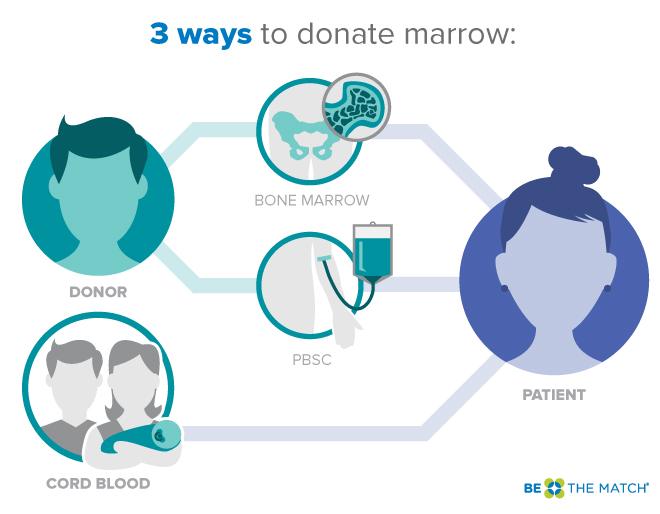
There are three sources that a patient can use to replace her diseased cells with healthy ones:

  • Bone marrow: The cells inside your bones
  • Peripheral blood: Circulating blood from which doctors collect stem cells.
  • Umbilical cords: The doctors collect blood from umbilical cords after the birth of a baby.

The best source of healthy cells depends on the patient and her doctor’s recommendations.  

How to Donate Your Bone Marrow

bone marrow donation
Sign up to be a donor today!
Signing up to donate your bone marrow is simple. You simply jointhe bone marrow registry online or at a Be the Match donor registry drive. 

I signed up online. When I did this, I reviewed the criteria to make sure that I qualified to be a donor and provided my name, address and other contact information. While I was asked to make a $100 donation, it was not necessary to join the registry. If you are 44 years old or younger, you can join for free if you are on a tight budget.

After signing up, I received a registration kit in the mail. The kit has a big cotton swab that you rub against the inside of your check to collect cells. After swabbing your cheek, per the instructions that come in the kit, you send the sample back to Be the Match. The agency will analyze your sample and keep your information on file. 

If a patient in need has at least six of the eight same human leukocyte antigens (HLA) as you, someone will contact you. 

Once you are in the registry, you can call Be the Match to request a copy of your HLA report. I just made this request, and they are mailing and emailing it to me today. 

Getting Tested and Donating for a Specific Person

When you sign up for the Be the Match Registry, you commit to donating to any patient in need. Its registry does not provide private testing or testing for a specific patient.  

For private testing services, contact Kashi Laboratories at www.bonemarrowtest.com or 1-877-565-3287. At the time of publication, the testing kit is about $200. After you submit the kit and receive the results, you can forward it to a patient’s doctor to see if you are a potential match. 

Like blood, the body replenishes its supply of bone marrow after a donation. It doesn’t take many healthy cells to save a life. Learn more about bone marrow donation process.